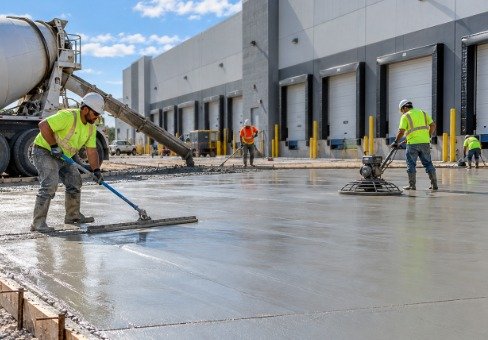
Crew placing a new concrete loading apron in front of warehouse loading docks

Parking & Access Area Concrete in Los Angeles

Concrete parking lots, parking pads, driveway and garage aprons, curbs and gutters, accessible parking, curb ramps, loading zones, loading docks, and drive lanes.

Parking & Access Area Services

Reliable Access for Vehicles and People

Concrete parking and access areas need to handle vehicle weight, repeated traffic, drainage, turning movements, and daily use while remaining stable and easy to maintain. These surfaces are commonly used around homes, apartment properties, commercial buildings, warehouses, offices, and other sites where reliable vehicle access is important.

The right concrete design depends on how the area will be used. A residential parking pad may have different requirements than a commercial loading area or accessible parking zone.

Our parking and access area concrete services include concrete parking lots, parking pads, concrete aprons, driveway aprons, garage aprons, curbs, gutters, handicap parking areas, loading zones, and loading dock concrete.

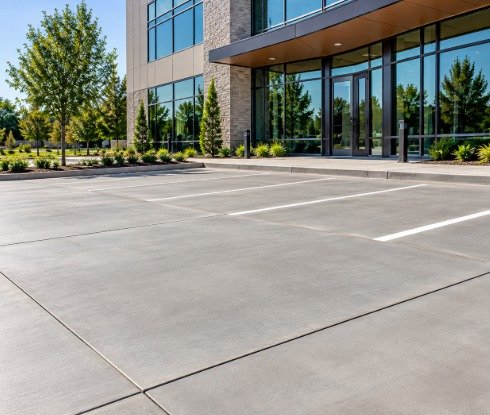
New concrete parking lot with white striping in front of a modern office building
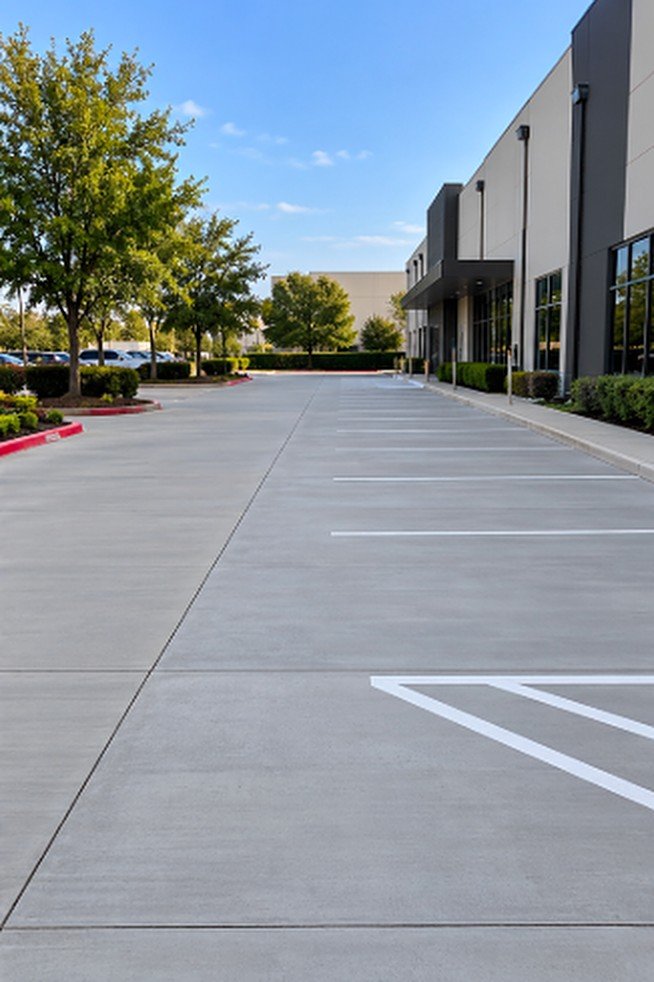
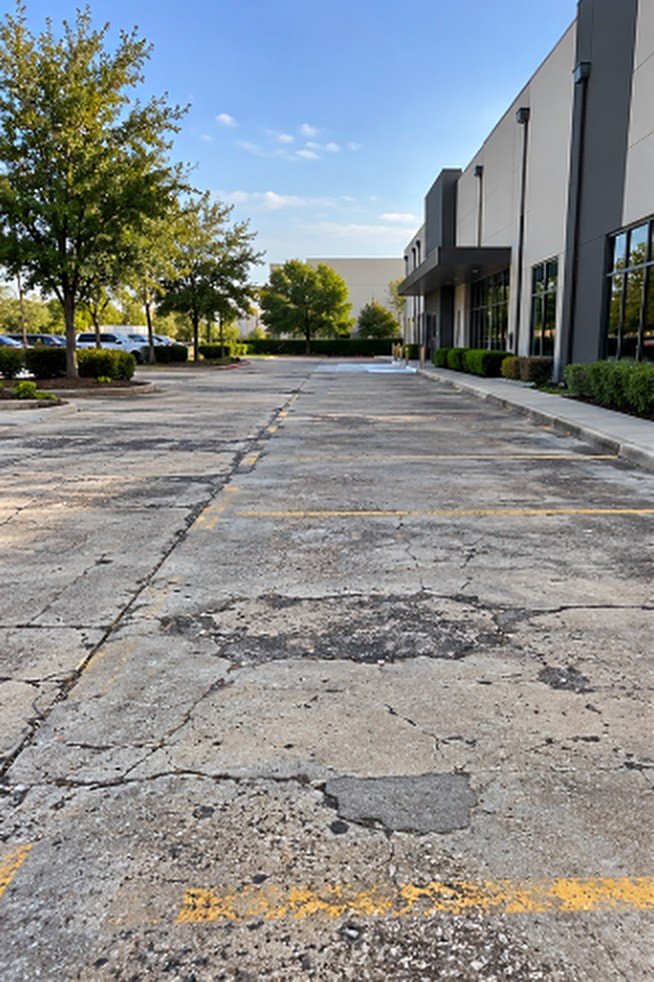
Parking lot after replacement with new concrete and striping Parking lot before replacement, cracked and patched

Concrete Parking Lots

Concrete parking lots provide durable surfaces for cars, vans, trucks, and other vehicles.

A parking lot should be planned around:

  • Vehicle traffic
  • Stall layout
  • Turning space
  • Entrances and exits
  • Drainage
  • Pedestrian routes
  • Accessible parking
  • Curbs
  • Lighting
  • Loading areas

Concrete thickness and reinforcement should match the expected traffic.

Commercial parking lots may also require heavier sections in areas used by delivery trucks or service vehicles. See our commercial concrete services.

Parking Lot Installation

Concrete parking lot installation begins with site preparation and grading.

The process may include:

  1. 1Excavation
  2. 2Base installation
  3. 3Compaction
  4. 4Forming
  5. 5Reinforcement
  6. 6Concrete placement
  7. 7Joint installation
  8. 8Finishing
  9. 9Curing

Proper drainage is especially important across large parking surfaces.

The lot should be graded so water moves toward appropriate drainage areas instead of collecting in low spots.

Parking Lot Repair

Parking lots can develop cracks, settlement, broken joints, surface deterioration, and damaged edges.

Repairs may include:

  • Crack repair
  • Joint repair
  • Grinding
  • Leveling
  • Patching
  • Partial slab replacement

Heavy traffic areas should be evaluated carefully because repeated vehicle loads can worsen damaged sections.

Extra Parking

Concrete Parking Pads

Concrete Parking Pads

Concrete parking pads create dedicated space for one or more vehicles without building a complete parking lot.

They may be used for:

  • Cars
  • Pickup trucks
  • Work vans
  • RVs
  • Boats
  • Trailers

Parking pads can be installed beside a driveway, garage, home, commercial building, or storage area.

The slab should be designed around the expected vehicle weight and regular use.
Residential Parking Pads

Residential parking pads can provide additional off-street parking.

They may be useful for:

  • Second vehicles
  • Guest parking
  • Work trucks
  • Trailers
  • Recreational vehicles

The pad can be connected directly to an existing driveway or installed as a separate parking area.

Drainage and access should be planned so vehicles can enter and exit comfortably.

Commercial Parking Pads

Commercial parking pads may be used for fleet vehicles, service vans, maintenance trucks, or designated equipment.

These areas may require heavier concrete than typical residential pads.

The design should consider:

  • Vehicle weight
  • Turning radius
  • Frequency of use
  • Drainage
  • Access routes

Transitions

Concrete, Driveway, and Garage Aprons

Concrete Aprons

Concrete aprons create transition areas between different surfaces or structures.

They are commonly installed near:

  • Garages
  • Driveways
  • Parking lots
  • Loading docks
  • Commercial buildings

An apron can help distribute vehicle loads and create a smoother connection between pavement and the structure.

Driveway Aprons

A driveway apron is the section where a driveway connects to the street, sidewalk, or another access surface.

This area often experiences frequent turning and vehicle loads.

Driveway apron services may include:

  • New installation
  • Replacement
  • Crack repair
  • Edge repair
  • Resurfacing

The apron should be aligned carefully with the driveway and surrounding curb or sidewalk.

Concrete Driveway Services

Garage Aprons

A garage apron is the concrete section directly outside the garage door.

It helps create a smooth transition between the garage floor and driveway.

Garage aprons can become damaged by:

  • Vehicle traffic
  • Settlement
  • Water
  • Poor drainage
  • Freeze-thaw movement

Repair or replacement may be needed if the apron becomes cracked, sunken, or uneven.

Edges and Stormwater

Curbs, Gutters, and Curb & Gutter Systems

Concrete Curbs

Concrete curbs help organize parking and access areas.

They may be used to:

  • Define parking lots
  • Protect landscaping
  • Separate pedestrian areas
  • Guide vehicles
  • Support drainage systems

Curbs can be installed in different shapes and sizes depending on the property.

Parking Lot Curbs

Parking lot curbs help control vehicle movement and create clear boundaries.

They may be installed around:

  • Islands
  • Sidewalks
  • Landscaped sections
  • Building entrances
  • Parking rows

Damaged curbs can also be repaired or replaced when they become cracked or broken.

Concrete Gutters

Concrete gutters help direct water through parking and access areas.

They are often installed alongside curbs or roadways.

Gutters should be designed with enough slope to move water toward:

  • Drains
  • Catch basins
  • Drainage channels
  • Approved runoff areas

Good drainage can help reduce standing water and surface damage.

Curb & Gutter Systems

Curb-and-gutter systems combine a raised curb with a drainage channel.

They are commonly used in:

  • Commercial parking lots
  • Apartment communities
  • Industrial properties
  • Roadway access areas

These systems help define traffic areas while also controlling stormwater.

Curbs, Gutters & Drainage
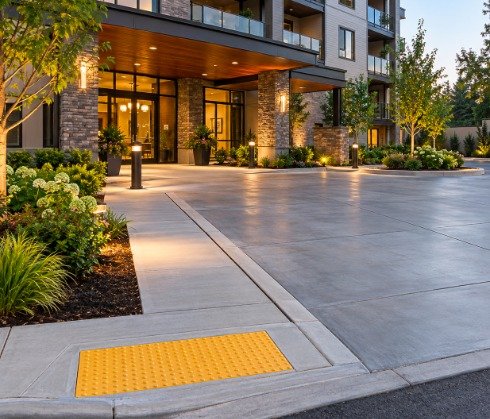
Concrete drop-off area and sidewalk with a curb ramp and yellow tactile warning pad

Handicap Parking Concrete

Accessible parking areas need smooth, stable surfaces and proper access to building entrances.

Concrete may be used for:

  • Accessible parking stalls
  • Access aisles
  • Curb ramps
  • Walkways
  • Landings

The layout should follow applicable accessibility requirements.

Slope and surface transitions are especially important.

Accessible Parking Access Aisles

Access aisles provide additional space beside accessible parking stalls.

Concrete can create a stable surface for wheelchair and mobility device access.

These areas should connect smoothly with:

  • Sidewalks
  • Ramps
  • Entrances
  • Accessible routes

Uneven joints or steep transitions should be avoided.

Concrete Curb Ramps

Curb ramps create transitions between parking areas and sidewalks.

They are commonly installed near accessible parking spaces and building entrances.

Important considerations include:

  • Ramp slope
  • Landing area
  • Width
  • Surface texture
  • Drainage

The design should integrate smoothly with the surrounding sidewalk and parking surface.

ADA Concrete Ramps
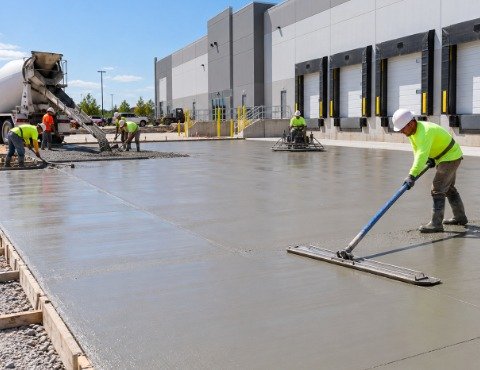
Crew pouring and troweling concrete in front of warehouse loading dock doors

Loading Areas

Concrete loading areas are designed for delivery trucks, service vehicles, and material handling.

They may be used near:

  • Warehouses
  • Retail stores
  • Restaurants
  • Industrial buildings
  • Commercial properties

Loading areas often need thicker concrete because of heavier vehicle loads.

The layout should also allow trucks to turn, stop, and back safely.

Loading Zone Concrete

Dedicated loading zones may be installed near entrances or service doors.

They may be used by:

  • Delivery vans
  • Box trucks
  • Freight vehicles
  • Maintenance vehicles

The surface should be designed around the expected weight and frequency of use.

Loading Dock Concrete

Loading dock concrete must support heavy trucks, forklifts, pallet jacks, and repeated material movement.

Concrete may be used for:

  • Dock aprons
  • Dock ramps
  • Truck staging areas
  • Service lanes
  • Loading platforms

These areas often require reinforced and thicker slabs.

Loading Dock Aprons

Dock aprons are located immediately in front of loading docks.

They experience concentrated truck loads and frequent turning.

A well-designed dock apron should provide:

  • Stable vehicle support
  • Smooth transitions
  • Proper drainage
  • Durable joints

Damaged dock aprons may require partial or full replacement.

Commercial Loading Docks

Heavier Vehicles

Truck, Fleet, RV, Boat, and Trailer Parking

Truck Parking Areas

Concrete truck parking areas can support heavier vehicles than standard car parking.

They may be used for:

  • Delivery trucks
  • Work vehicles
  • Fleet trucks
  • Commercial trailers

The slab thickness and reinforcement should match the expected axle loads.

Fleet Parking Concrete

Businesses with multiple service vehicles may benefit from dedicated concrete fleet parking.

Fleet areas can be designed around:

  • Vehicle quantity
  • Daily movement
  • Overnight parking
  • Wash areas
  • Maintenance access

Concrete can provide a durable surface for frequent use.

RV Parking Pads

Concrete pads can be installed for recreational vehicles.

RV pads should be sized around:

  • Vehicle length
  • Vehicle width
  • Weight
  • Access
  • Turning space

Drainage and reinforcement are important because RVs can place substantial loads on the slab.

Boat Parking Pads

Concrete parking pads may also be used for boats and trailers.

These areas should provide enough space for backing, turning, and storage.

A properly prepared base can help reduce settlement under repeated trailer loads.

Trailer Parking Areas

Trailer parking areas can be designed for:

  • Utility trailers
  • Work trailers
  • Boat trailers
  • Commercial trailers

The concrete should be installed with the expected load in mind.

Concrete Slab Parking Pads

Keeping Traffic Moving

Drive Lanes, Access Roads, and Vehicle Entrances

Drive Lanes

Concrete drive lanes connect entrances, parking areas, service zones, and loading docks.

They may experience more traffic than individual parking spaces.

Drive lanes should be designed with:

  • Proper width
  • Turning radius
  • Drainage
  • Reinforcement
  • Joint placement

Commercial Access Roads

Some properties use concrete for internal access roads.

These may connect:

  • Parking lots
  • Warehouses
  • Loading areas
  • Maintenance buildings
  • Equipment zones

The design should match the expected traffic and vehicle weight.

Emergency Vehicle Access

Certain properties may need concrete access areas for emergency vehicles.

These routes may require additional width, turning space, and load capacity.

The final design should follow applicable local requirements.

Concrete Vehicle Entrances

Vehicle entrances connect streets with parking or service areas.

They should be designed around:

  • Traffic volume
  • Vehicle size
  • Drainage
  • Curb transitions
  • Sidewalk crossings

High-use entrances may require heavier concrete sections.

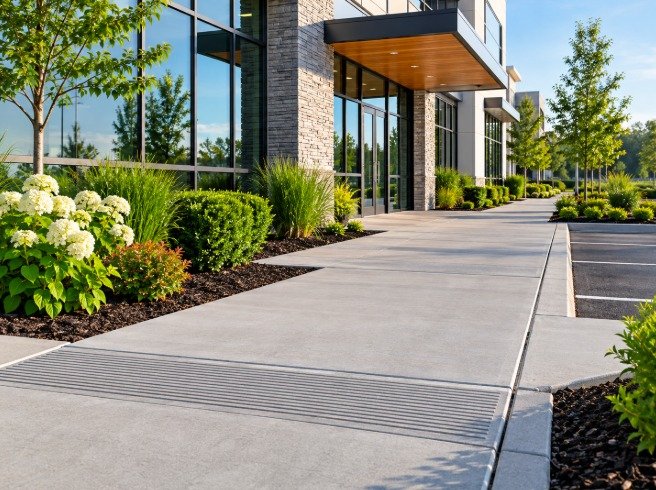
Concrete walkway and parking edge with a long trench drain grate

Parking Area Drainage

Drainage is one of the most important parts of any parking area.

Poor drainage can lead to:

  • Standing water
  • Erosion
  • Settlement
  • Surface deterioration
  • Water entering buildings

Drainage solutions may include:

  • Sloped concrete
  • Curbs and gutters
  • Trench drains
  • Catch basins
  • Drainage channels

Trench Drains

Trench drains can be installed across parking areas, driveways, or loading zones to collect surface water.

They are useful near:

  • Garages
  • Loading docks
  • Commercial entrances
  • Sloped driveways

The concrete around the drain should be installed carefully to maintain proper flow.

Growing and Maintaining

Expansion, Replacement, and Repair

Parking Lot Expansion

Existing parking areas can be expanded when more vehicle capacity is needed.

Expansion may involve:

  • Removing landscaping
  • Extending existing slabs
  • Adding new parking rows
  • Creating new access lanes

The new concrete should be integrated with the existing layout and drainage system.

Parking Area Replacement

Parking surfaces may eventually require complete replacement.

This can be necessary when there is:

  • Widespread cracking
  • Major settlement
  • Severe joint failure
  • Poor drainage
  • Extensive surface deterioration

Replacement allows the base, slope, drainage, and layout to be improved.

Removal & Replacement

Concrete Access Area Repair

Access areas can become damaged by traffic, settlement, and water.

Common repairs include:

  • Crack repair
  • Joint repair
  • Grinding
  • Leveling
  • Section replacement
  • Curb repair

Repairs should focus on restoring smooth vehicle and pedestrian movement.

Concrete Repair Services

Parking Lot Joint Repair

Joints in parking lots help manage concrete movement.

Over time, they may become damaged or widened.

Joint repair may involve cleaning, sealing, filling, or rebuilding damaged edges.

Uneven Parking Concrete Repair

Settlement can create uneven areas between slabs.

This can affect:

  • Vehicle movement
  • Drainage
  • Pedestrian access
  • Accessibility

Repair may involve grinding, leveling, lifting, or slab replacement.

People and Appearance

Decorative Concrete, Drop-Off Areas, and Pedestrian Access

Decorative Parking Concrete

Decorative finishes may be used in selected parking and access areas.

Common applications include:

  • Building entrances
  • Pedestrian crossings
  • Parking lot borders
  • Drop-off zones

Stamped, colored, or exposed aggregate concrete can help create visual separation.

Drop-Off Areas

Concrete drop-off zones may be installed near:

  • Hotels
  • Offices
  • Medical facilities
  • Apartment buildings
  • Schools

These areas should provide smooth vehicle access and clear pedestrian transitions.

Pedestrian Access Through Parking Areas

Parking areas should also provide safe pedestrian routes.

Concrete can be used for:

  • Sidewalks
  • Crosswalk zones
  • Ramps
  • Islands
  • Entry paths

These areas should be clearly separated from vehicle traffic where possible.

Residential Parking & Access Concrete

Residential projects may include:

  • Parking pads
  • Driveway aprons
  • Garage aprons
  • RV pads
  • Boat pads
  • Side access areas

The layout should fit the property without interfering with walkways or drainage.

Commercial Parking & Access Concrete

Commercial properties may require complete systems that include:

  • Parking lots
  • Drive lanes
  • Loading areas
  • Curbs
  • Gutters
  • Accessible parking
  • Pedestrian routes

The design should support daily operations while maintaining reliable access.

Commercial Concrete Services

Choosing the Right Parking & Access Concrete Solution

Every parking and access project should be designed around actual use.

A small residential parking pad may require a different solution from a commercial truck loading area.

Get A Free Estimate

Important factors include:

  • Vehicle type
  • Traffic volume
  • Load weight
  • Drainage
  • Accessibility
  • Turning space
  • Pedestrian access
  • Existing concrete condition

Complete Parking & Access Area Concrete Solutions

Our parking and access area concrete services include parking lots, parking pads, driveway aprons, garage aprons, curbs, gutters, accessible parking, curb ramps, loading zones, loading docks, fleet parking, RV pads, truck parking, and concrete access lanes.

Whether the project involves additional residential parking or a large commercial access system, proper preparation and design are essential.

With the right base, slab thickness, reinforcement, drainage, and layout, concrete parking and access areas can provide reliable vehicle and pedestrian use for many years.

Parking & Access FAQs

Parking and Access Area Questions, Answered

It depends on what will park there. Pads for passenger cars are often around 4 to 5 inches thick, while RV pads, truck parking, and trailer storage usually need thicker concrete with added reinforcement because of the heavier loads. Soil conditions and base preparation matter just as much as thickness. We recommend the right design after looking at your site and the vehicles you plan to park.

In most cases, yes. Work that touches the public right-of-way, such as a driveway apron at the street, a new or widened curb cut, or the city sidewalk, usually requires a permit from the city and must meet its standards. Work entirely on private property may have fewer requirements. We review your project, explain which permits may apply, and can help with the paperwork.

Both have advantages. Concrete usually lasts longer, needs less routine maintenance such as sealcoating, holds up well to heavy loads and hot Los Angeles summers, and has a lighter surface that stays cooler. Asphalt often costs less upfront but typically needs more frequent maintenance. We can walk you through long-term costs so you can choose the best option for your property.

Yes. We build accessible parking stalls, access aisles, curb ramps, landings, and smooth connections to sidewalks and building entrances. Slopes, widths, and transitions must follow the accessibility requirements that apply to your property, so we work from your project plans or with your designer or consultant. We can also fix uneven joints and steep transitions that make existing routes hard to use.

Pricing depends on the size of the area, slab thickness, reinforcement, removal of old pavement, grading, drainage, curbs, and site access. As a general guide, many parking pads, aprons, and parking areas fall around $8 to $20 per square foot, with heavy-duty truck and loading areas on the higher end. We provide a free on-site estimate with a detailed written quote.

Book Service

Get Your Parking or Access Project Started

Fill out the form below and our team will get back to you quickly with a free estimate.

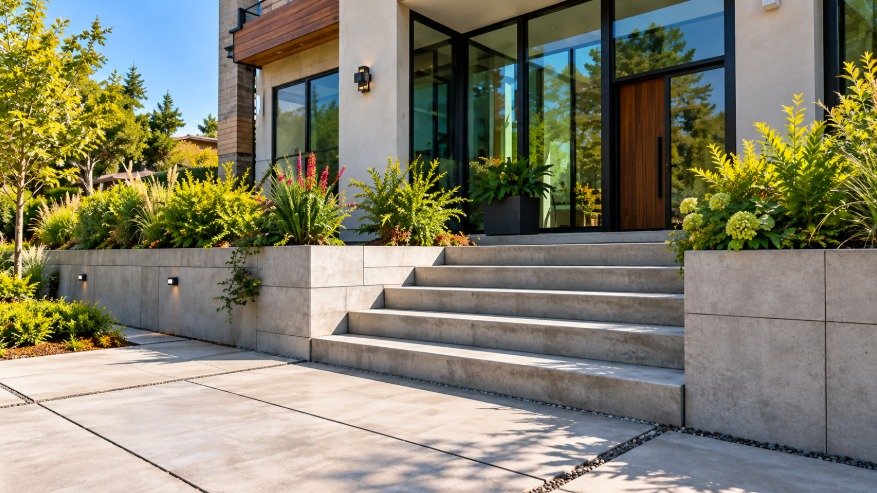
Concrete steps and walkway at a modern Los Angeles home
  • Free Estimates
  • Quick Response
  • Service Throughout Los Angeles
  • Residential & Commercial
  • Licensed, Bonded & Insured